Getting Others to Their Fitness Goals

As a runner and an athlete, setting goals and working to reach them is a major part of my life. It’s what drives me to get better and it makes me happy. Even more fun though, is helping other people reach their goals.

Back in high school I was always putting together plans and forcing my friends to run sprints in an empty gym during the off-season to get ready for basketball. For years I’ve acted as a personal trainer for my Mom setting up workout plans for her and teaching her how to swim so she could add a new cardio element to her routine. A couple years ago, I got to take things a bit further.

I saw an ad for a company called Custom Fitness Concepts (CFC) looking for outdoor boot camp instructors. I had taken boot camp classes for a few years and thought this would be a blast, so I replied to the ad with my background and reasons for wanting the job. After a month and a half of CFC’s in-house training program and shadowing other instructors, I was getting my own class. It would be a new site up in Quincy Park and would be held Monday through Friday at 6 a.m.

I had five people show up for my first class – four were friends of mine. Attendance was a bit rocky at first, but eventually it built up and I had a pretty solid showing most mornings. During the nicer months, especially when we were running Groupon deals, I often had 20+ people showing up. Despite the early hour (I’m not much of a morning person), I absolutely loved it.

A few months later I took over the evening class at Quincy Park as well for a trainer moving out of town. That one met Monday through Thursday after work at 6 p.m. I was able to do both classes and my day job for a little over a year before it became a bit too much and I dropped the morning class. If only there’d been a financially feasible way to turn fitness-related work into a full-time gig!

It was so fun to see so many people coming out and trying to get in better shape while having some fun doing it. Although, a lot of my bootcampers out there might say that I was the only one having fun, they kept coming back, so I don’t believe it! It was especially great to get to know the regulars who came over a long period of time, and see how much of a transformation some of them made. If you’re in the DC/NoVa/Maryland area and are looking for a kick-butt workout, look no further than CFC.

I had to give up teaching boot camp when I started my new job and at the same time my car died at the beginning of this year, but it was an awesome experience. This summer I started doing some personal training for CFC. I only have one client a couple days a week right now since that’s pretty much all my schedule allows for, but it’s great to be back to helping someone take a step towards getting more fit and leading a healthier lifestyle.

While it’s no doubt rewarding to reach my own fitness goals, there is nothing quite like the feeling of knowing I helped someone else do something they didn’t know or never thought they were capable of accomplishing.

How do you reach your fitness goals? Do you like to go at it solo or take group classes? What are your favorite types of classes?

Election Night in D.C.

I often find politics frustrating and don’t understand why neither side seems capable of any compromise, but one thing I do find cool is the atmosphere in D.C. during an election season. It’s treated like a sporting event.

For the debates and the election, you can find lists of area bars best for viewing and many offering election-themed specials. I caught the second presidential debate at a bar near Capitol Hill with some friends. We walked in a bit early and saw that the Yankees game was on. We checked with a bartender to see if there would be a TV showing the debate, and got a quick response that at debate time all the TVs would be switched over and the volume turned on. I don’t think there are too many cities where a debate trumps baseball playoffs!

On election night you can basically go to any bar in town to watch the returns come in. We ended up in Chinatown and watched with a packed crowd cheering or booing as results came in for or against their candidates. It was pretty entertaining, and regardless of how you feel about how the night’s results turned out, it is cool to see that level of interest in the direction our country is going.

Should the NYC Marathon Have Been Cancelled?

There has already been a boatload of coverage and debate about whether or not the New York Road Runners (NYRR) and the City made the right call canceling the New York City Marathon. I think they made the right decision, but they made it too late. Regardless, I would not have wanted to be in charge of making that decision. It was a very tough call.

There were plenty of reasons holding the marathon made sense. The marathon brings $340 million dollars to the city, which could go a long way in helping residents and small businesses trying to recover from the devastation caused by Super-Storm Sandy. According to NYRR, no resources would have to be diverted from relief efforts to hold the race, which was one of the same reasons given for still holding the Giants game. This post on FloTrack.org does a good job of summing up how important this marathon is for a lot of professional runners, especially those who aren’t at the top of the pack. MarathonGuide.com posted a message on their homepage saying the event was cancelled only because of the media turning public perception against it.

Former Mayor Rudi Giuliani even came out and supported Mayor Bloomberg’s initial decision to hold the race, saying how important big events like this race are to NYC. He said making sure that race still happened after 9/11 was a top priority for him. After hearing this I started to think it made sense to still hold the race. After all, nothing quite symbolizes community and resilience like 47,000 runners taking on a marathon. So, the show must go on.

Then more stories started to roll out, many that were not even showing up in the news. This was no ordinary storm and it caused an unbelievable amount of destruction. How can you justify handing out huge amounts of water when the spectators might need it more? How can you justify filling hotels with tourists when they could be used to house people who had just lost their homes and all of their belongings? Too many people were hurting too badly to let the race go on – not to mention the logistical nightmare it was going to be to transport all the runners to the start on Staten Island, which was hit very hard by the storm.

Many people criticized runners for being selfish about getting upset over wasting months of training when others had just lost everything. I don’t think this is fair though, and I think many runners probably handled it better than onlookers expected. They came for the race because they’d been told it was still on. The decision really should have been made earlier instead of waiting till the last minute, but even this turned into a positive as thousands of runners ended up pitching in for the relief efforts.

There will be other marathons and most runners get that. My friend Lindsay and I ran the Country Music Marathon in Nashville in 2010. Well, at least we started it. Forecasts for race day were a bit foreboding, predicting severe thunderstorms and a possible tornado, but the race went on. The day actually started off beautifully with no sign of a storm coming, but it turns out there’s something to that saying, the calm before the storm.

Around the halfway mark, the sun disappeared behind the clouds, the sky turned very gray and eventually it opened up. Thunder and lightning rocked the course as the rain got harder and some hail even started to fall. As I approached mile 20, a cop with a bullhorn was yelling at me that the course was being shut down. I didn’t want to hear it though, so needless to say I may have used some unkind words and ran around the officer. I was on pace for a more than 30-minute PR and wasn’t going to let a little storm get in my way. The volunteers forming a human wall at mile 21 forcing people toward the finish line did however get in my way.

I angrily ran the last mile to the finish and took a medal in disgust after “only” running 22 miles. After meeting up with Lindsay and making our way back to our hotel though, we were able to gain some perspective and even laugh about what had just happened. We were able to enjoy a great night out in Nashville, while joking about our really expensive training run. The storm let up the following day and we were lucky to fit in a trip to the historic Grand Ole Opry before leaving town.

We got out just before more major storms hit, leaving most of Nashville under water including the Opry. Many people lost their homes. We just couldn’t run a race. You can’t compare the two, and we – like many of the runners unable to compete in the NYC marathon – had the perspective to understand that. It made for quite and experience and quite a story.

While it’s a bummer for the runners who put in so much work to train for the marathon, it’s absolutely tragic what many of the residents of NYC and New Jersey are going through. In my opinion, NYRR and the City made a very tough call, but they made the right call.

What do you all think about the decision to cancel the marathon? Was it the right call? If you were planning on running the marathon, did you pick a back-up race? Let me know in the comments – I’d love to hear from you!

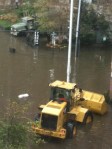
Check out pics below taken by my brother in Hoboken a week after the storm and pics from my 2010 trip to Nashville.

Deep Tissue Massage: Relaxation or Torture?

As part of my physical therapy I had a deep tissue massage before one of my recent sessions. My muscles had been so tight and flared up that my physical therapist wasn’t able to get to the joint to work on it,  so the massage was supposed to help loosen things up and relax the muscles.

I’ve never had a deep tissue massage before, so I had no idea what I was in for. When I think massage, I think relaxing and something that makes you feel good. If this is your thought too and someone suggests you get a deep tissue massage, then I suggest you run away fast! If we just sent massage therapists to interrogations we could learn any secrets out there. It was one of the more painful experiences I’ve had, and I’ve run 9 marathons! I had to constantly force myself to remember to breathe.

In all seriousness though, despite the initial pain, I saw immediate gains in my session that day. I even went back for more before one of my sessions the following week. Combined with the daily foam rolling and icing, the area around my hip flexors, quads and IT band is starting to feel human again and a bit less like steel! You can actually feel some of the tissues in there and I’m much better at relaxing my muscles rather than tightening them up and muscle guarding to protect from the pain when my physical therapist works on my legs. It’s great to notice some progress and feel like I’m closer to getting back out on the road again.

I’m told that eventually as the injury goes away, deep tissue massages will get less painful and can be a helpful tool when training for and running marathon distances. Based on the results I’ve had so far, I believe it!

Have you ever had a deep tissue massage? What did you think? I’d love to hear from runners that incorporate them into their training and recovery plans.

DC Photo Safari

Last weekend I took a Washington Photo Safari class at the National Museum of the American Indian. I’ve previously taken their Monuments & Memorials and Monuments at Night safaris and absolutely loved them both, leaving with a much better knowledge of how to use my DSLR camera. This class, Canon Rebel DSLRs: Practical Use Digital SLR Photography, did not disappoint.

I bought my Canon XSi a few years ago since I love taking photos and wanted to be able to do more than I could with my point-and-shoot. I also had a big trip to Ireland coming up in a few months that I couldn’t wait to bring the camera on. I quickly learned that just having a nice camera didn’t guarantee great pictures, so I started taking various classes. Between the photo safaris and a digital photography class Arlington County offered I learned quite a bit, but after some time of not using my DSLR for awhile, it was time for a refresher.

Two of my biggest takeaways from this Photo Safari class were metering and white balance. I learned the difference between evaluative metering, center-weighted metering and spot metering, which is extremely helpful when you’re trying to take a picture of someone that’s backlit. From now on I’ll make sure no one appears like a dark spot in front of a bright background in my shots.

I’ve learned to use the different white balance settings several times before, but it had been awhile so I’d gotten back to keeping my camera on the auto white balance setting. I understand again when it’s best to use each setting and even better, now know how to create custom white balance settings for any situation I’m shooting in.

I’m certainly no expert, but I love taking photos and learning new ways to take better shots creating some great lasting memories!

Below are two sets of pictures. The first set shows the same picture taken with two different metering settings and the second set shows the same picture shot with two different white balance settings.

Out and About D.C. Style

One of my favorite things about living in the Washington, D.C. area is that it never gets old to play tourist. Whenever someone comes to visit, it’s a great excuse to get out and explore. My parents were coming down for a visit recently and since they’ve been here many times, we wanted to come up with something we hadn’t done yet.

Amazingly in all the years they’ve been coming down, we’d never gone to the National Archives. I haven’t been in years either, so we decided to make an afternoon of it. The highlight of the Archives of course is that it houses the Declaration, the Constitution and the Bill of Rights. Seeing these documents in person as opposed to them just being some abstract thing you learn about in history class is unbelievably cool. Yes, I’m a total nerd!

Our main reason for visiting the Archives on this trip, however, was to see a new temporary exhibit called To The Brink: JFK and the Cuban Missile Crisis. The exhibit looks back at the crisis and features real-time White House recordings from Kennedy’s meetings in October of 1962. Also at the exhibit are chairs used by President Kennedy and Soviet Premier Khrushchev during the June 1961 Vienna Summit. It has personality studies of Khrushchev and Fidel Castro, satellite photos of missile sites under construction in Cuba,  a map of Cuba used and annotated by President Kennedy,  secret correspondence between Kennedy and Khrushchev and a synopsis of a speech that never had to be delivered that President Kennedy drafted if he had to announce an attack to “destroy the nuclear build-up in Cuba.”

The exhibit was great – full of information and cool pieces of history. I could’ve spent hours more there listening to all of the recordings from Kennedy’s meetings and hope to get back before the exhibit closes. If you’re planning on being in D.C. between now and February, this is a can’t miss museum.

Time to Get Healthy

After an injury consult from Fast Track physical therapy at the Run for the Parks 10k, I set an appointment with their office so I could figure out what was going on. I’d been ignoring pain for much too long (I’m sure this comes as no surprise to anyone who knows me), and it turns out I’d done quite a number on my legs, especially my hip flexors.

My mobility is limited and my hamstrings, IT band, quads and calves are all extremely tight. I also had an appointment with Dr. Ochiai, an orthopedist, for X-Rays that showed a small build-up of excess bone on my left hip, which could cause torn cartilage in the hip joint. We agreed that surgery would be a last resort so we decided to hold off on an MRI at this point and see how I’m feeling after a few weeks of physical therapy.

I’ve gotten several physical therapy sessions under my belt now and it seems like things are going in the right direction. Liz, my physical therapist at Fast Track, is excellent. She’s given me a series of exercises and lots of stretches to do everyday to help get my flexibility back to where it should be. It apparently takes about 10 weeks to really have an effect, so I’m going to have to have some patience, which isn’t exactly one of my stronger qualities. I’m also foam rolling and icing everyday to help with the pain and hopefully loosen things up. After using my rolling pin as a roller for the past year, I finally broke down and got a real one from Amazon!

Watching the Marine Corps Marathon instead of running it was a bit of a bummer last week, but it’s also hard not to get excited seeing so many people out there running such an awesome race. I was able to defer my entry, so I’ll have an automatic entry into next year’s race. I’m going to really work these next couple months to get myself healthy again and then be smart enough to stay that way this time – mostly because I want to get back to my goal of qualifying for Boston, but also because I’m going a bit insane not being able to run!

Book Review: Hansons Marathon Method

Since I currently can’t get my usual running fix (more to come on that in tomorrow’s post), I’ve started reading about running. Yes, I’m addicted. I’ve been familiar with the Hansons-Brooks Distance Project and the great professional athletes they’ve produced including Desiree Davila, so I was excited to hear that they had a new book out detailing how everyday runners can use their method for marathon success.

Thanks to my impulse buying and Amazon Prime membership, I had a copy of Hansons Marathon Method: A Renegade Path To Your Fastest Marathon in my hands just two days after learning about it. Written by Luke Humphrey, an elite Hansons runner who also has a master’s degree in exercise science, with Kevin and Keith Hanson, the book outlines their philosophy and program for a successful marathon covering every aspect from training to strategy to recovery. In just a couple of days I’d read the book from cover to cover and I was sold. I’m going to give their program a shot for my next marathon.

Most marathon training programs are fairly similar. For beginners you usually run three shorter runs during the week and a long run on the weekend peaking around 20 or 22 miles. As you get more advanced, speed workouts and higher mileage are added to the training schedule, but the long run – still peaking at 20 or 22 miles – remains a staple of most programs. The Hansons method takes a different approach. It “teaches a strategic and scientifically grounded approach to everything from the long run to speed workouts to pacing,” writes Kevin Hanson in the book’s foreword. The Hansons method has evolved over the years helping runners of all levels to marathon success since the 1990s.

The biggest difference in the Hansons program is the long run. Rather that the typical 20-miler, the longest training run in the standard Hansons program is 16 miles. The reason this works, Humphrey writes, is that the long run should simulate the last 16 miles of the marathon, not the first 16. It’s all based on experiencing the cumulative fatigue you experience in a marathon without completely zapping your energy for the next week of training. The book cites a guideline that your long run should not exceed 25-30 percent of your weekly mileage. For beginners who have completed just three short runs during the week,  a 20-miler on Sunday can sometimes be 50 percent or more of their weekly mileage. This can be demoralizing and lead to injury – both of which can turn people off from running.

The book covers the philosophy behind the program and delves into the physiology of running covering issues like glycogen depletion and VO2 max. From there Humphrey’s discusses the training program components including easy mileage, which is made up of warm-ups and cool downs, easy days and recovery days, and something of substance (SOS) workouts, which include speed, strength, tempo runs and long runs. The book goes over proper pacing for each of type of run before outlining it’s training programs including both a beginner program and an advanced program. It also talks about program  modifications for when life and injuries get in the way.

After covering the program, the book moves into the strategy side of things. It talks about setting race goals; how to incorporate supplemental training such as cross-training, strength-training and flexibility; and marathon nutrition and hydration during workouts, on race day and for recovery. It moves on to marathon gear, race tactics and post-race recovery – leaving no stone unturned. Finally, the book includes an appendix showcasing the elite Hansons program and describing how its principles are very similar to the ones in their beginner and advanced programs for everyday runners. It even shows Humphrey’s training program for the 2011 San Diego Rock ‘n’ Roll Marathon (this course was my first marathon back in 2005!) where he placed fifth in a personal best time of 2:14:27.

If you’re a runner, you’ll want to give this book a read. Even if you decide to stick with your current training program, you’ll most certainly learn something from it. I’d love to hear about the programs you’ve used in the past, and if you’ve had experience with the Hansons method in the comments section.

Let Down: Lance Armstrong, Cheating and Lies

By now everyone has heard the news that the U.S. Anti-Doping Agency (USADA) has stripped Lance Armstrong of his 7 Tour de France titles for doping and the use of performance enhancing drugs, and witnessed the fallout as he has been banned from races and dropped by sponsors. For years as athlete after athlete is found to have cheated to enhance their performance, I’ve always said the only one I would be truly surprised and hurt by would be Lance Armstrong.

When the news first came out that the USADA was stripping him of his titles and Lance was giving up the fight by refusing to contest the ruling in what he deemed an unfair fight, I believed Lance’s PR machine that this was just a witch hunt. He’s never failed a drug test they said, and I echoed. Someone was clearly out to get him and upset that this brash Texan had won France’s and cycling’s greatest race seven straight years after recovering from cancer that nearly killed him.

Then the USADA released their Reasoned Decision. I’m just about done reading the 202-page case against Armstrong and I’m devastated. He cheated. He lied. There is no doubt. It was witnessed – and not just by people with an axe to grind or a deal to cut. There were positive tests. There were not nearly as many tests as he claimed. It was calculated and sophisticated. There was bullying and encouraging of others to participate in and to keep the scandal a secret. If you have time to read even just a few pages of the report you will be stunned by the overwhelming evidence against him.

While some shout “I told you so,” I am just sad. Heartbroken in fact. Did he cheat in some part in the name of a good cause? Yes. Were the vast majority of other cyclists also cheating? Yes. It doesn’t matter and it doesn’t make it better. Lance always claimed to be above the cheating and boasted about conquering cancer and winning cycling’s most grueling race clean while others were cheating. I have looked up to Lance for years as an incredible inspiration. So have many people fighting cancer looking to defy the odds. Turns out it was all based on cheating and lies.

He deserves to have the titles stripped. He deserves to be banned from competition. He deserves to be dropped by sponsors – those companies will certainly find other ways to donate to the fight against cancer. He deserves to lose the Olympic medal.

Lance, I looked up to, respected you and was inspired by you – and you let me down. You let down your fans and more importantly you let down so many people fighting cancer and other diseases who needed to believe in the impossible. What a disappointment!

Truly, too good to be true.

Olympic Cities

I’ve been on a bit of a travel binge for the last year or so, and while I’m looking forward to a November mostly free of travel, I have had a lot of fun and gotten to see some very cool cities along the way. Recently I visited two cities that have hosted past winter Olympics.

In late September my boyfriend and I rented a car and got on the road bright and early to head up to Lake Placid, New York for my friend Lindsay’s wedding. (Side note: The Prius is an awesome car – better than I’d expected and the gas mileage is incredible.) It was a bit of a rainy drive, but the views and colors of the changing leaves as we got closer were fantastic.

After finally arriving we settled in at the Crowne Plaza and met up with friends at the Lake Placid Pub & Brewery. This was a great little pub with just about anything on the menu. After a long day of driving, we were all ready for a couple beers, and well, we pretty much attacked the appetizer menu. Check out Ian’s review over at Croutons Stuck in Futons for more on the brewpub.

Lake Placid hosted the Olympics in 1980 and 1932. Logistically I have no idea how this small city was able to do so, but we took full advantage of getting some time to check out the Olympic sites. Ian and I stepped out onto the currently cement outdoor speed skating track and visited the Olympic Museum. Most exciting was checking out the ice rinks and stepping onto the ice where the 1980 Miracle on Ice took place…even if I did get yelled at shortly after doing so to get off the ice!

A few weeks later I was off to Vancouver, British Columbia for a conference. Vancouver hosted the Olympics more recently in 2010. Before the work part of the trip started I was able to spend some time checking out the city. I saw the Olympic Cauldron and rode by BC Place Stadium on a bus tour of the city.

I rented bikes with a few coworkers and took advantage of unseasonably warm weather to ride along the seawall and take in some amazing views around Vancouver. I also got in several runs along the seawall, which were some of the most breathtakingly beautiful runs I’ve been on.

I always look forward to watching the Olympics every two years. I was lucky enough to win a drawing to be able to carry the Olympic torch on its way to the ‘96 Olympics in Atlanta. While in Greece to run the original marathon course, I got to stand right next to the Olympic flame in Marathon. It was great adding Lake Placid and Vancouver to my list of marathon experiences.

Enjoy pics below including a couple flashbacks to elementary school – rocking the giant glasses and scrunchie!