Seminar: Running Your Best Race

On Saturday, the DC Capital Striders hosted a seminar  at Lululemon in Georgetown called Successful Race Execution – Preparation, Fueling, and Pacing Strategy to Run your Best Race featuring RRCA certified running coaches Lisa Reichmann and Julie Sapper. Lisa and Julie are both experienced runners themselves and are also co-founders of local running company, Run Farther & Faster, coaching everyone from those doing their first 5k to runners looking to PR in a marathon.

They covered the right way to taper, nutrition both while your training and racing and pacing strategies. Some of it was new and some was info I’ve heard before, but it’s always great to be reminded. They highlighted the importance of the taper, which is good for me to keep hearing because like most runners I go a little stir crazy during that time and have trouble trusting that I won’t lose all my fitness in the week and a half or so before the race.

Their info on fueling was great. They talked about avoiding sugary foods so you don’t crash, embracing carbs and making sure to eat a protein/carb snack or meal within 20 minutes of finishing a run. They also gave some good advice on in-race nutrition including the invaluable – don’t ever mix Gu with Gatorade!
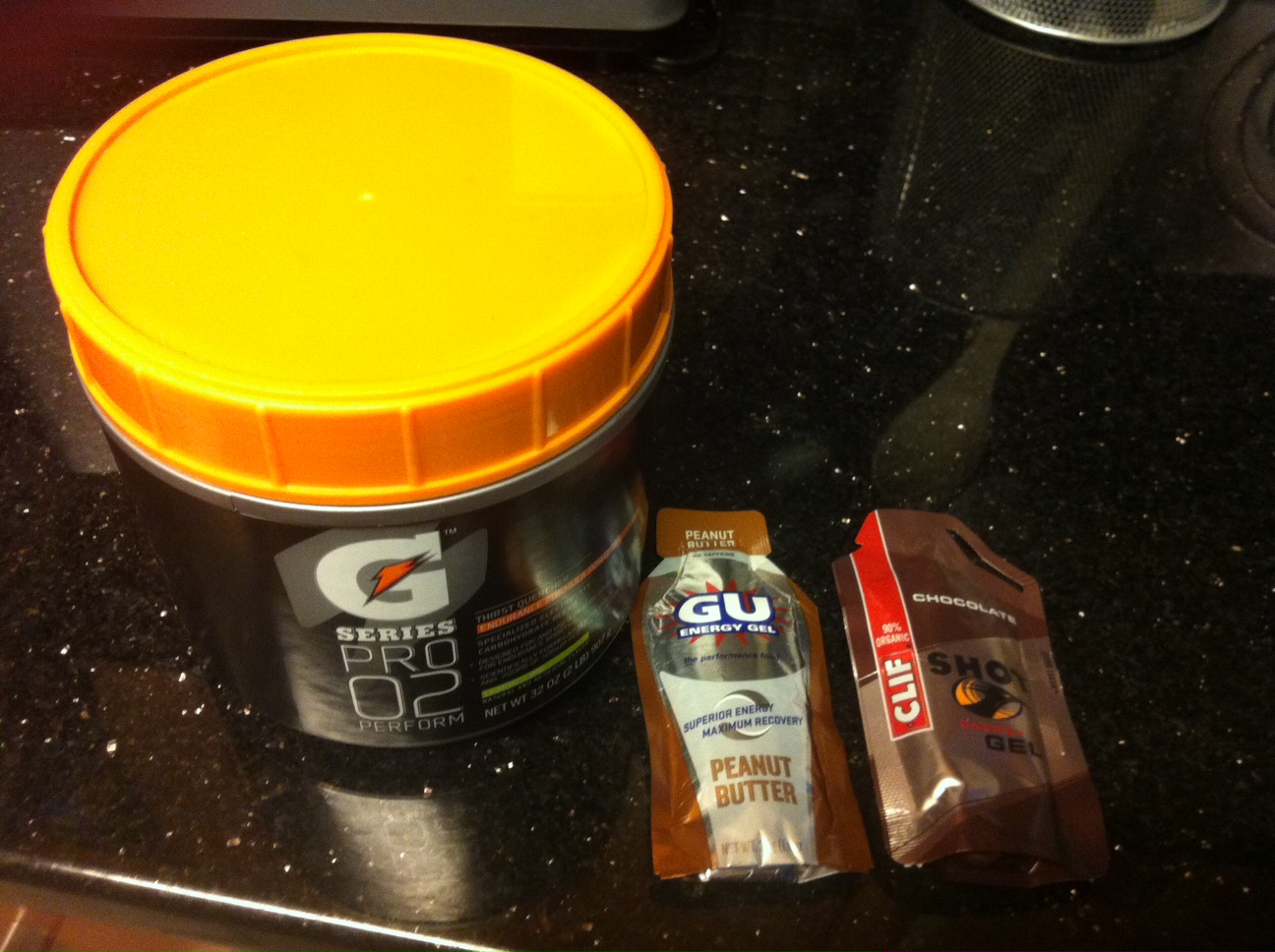
Gatorade and Gu - Do not mix!!

Gatorade and Gu – Do not mix!!

The top takeaway for me came when I asked Julie about her long runs. I have a tough time doing them one to two minutes slower than race pace as most training plans recommend. I always worry that there is no way I’ll be able to run the pace I want to come race day if I do that despite what a lot of the science says on the subject.

She said she used to have similar concerns at a point where she was about a 3:45 or so marathoner before hooking up with a coach and a running group and following the long-slow distance method. (You can run the last few miles of some of these slower runs at race pace as a confidence booster too.) That helped bring her down into the 3:20s. Since I’m just under the 3:40 mark now and the 3:20s is where I want to be, this was exactly what I needed to hear. Granted the same things don’t work for everyone, but hearing it form someone that it worked for as opposed to reading it in a book makes a big difference for me.

I’d love to hear about your training – what plans do you follow? How do you fuel along the way? Does the taper drive you crazy? Let me know in the comments!
 

Race Recap: Love the Run You’re With 5k

Sunday marked my first race of 2013 and my first real race back from the injured list. I ran in Pacers Love the Run You’re With (LTRYW) 5k for the first time and loved it. I didn’t PR, but that wasn’t the goal for this race, and I was very pleased with my finish time of 22:56. I’m making great progress and am on my way to getting back to where I was at, and hopefully even better!

After hearing about the bone chilling temps from last year’s race I was sure glad how nice of a day it turned out to be. Temps were in the 30s and the sun was shining. I wore my Reebok long sleeve as a base layer topped by my Reebok 1/2 zip jacket and my Nike Pacers Ambassador t-shirt. I also had on an Under Armour hat, a neck gaiter, gloves, Nike pants and Zensah compression sleeves. I was WAY overdressed and started overheating about a half mile in. This does not happen to me often. I’m getting way too used to running in cold weather.

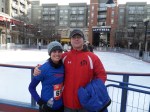
Ian got up early with me to drive me to the race, take pictures and cheer me on – more impressive than usual since we’d gone to a great Mardi Gras party the night before and had a few hurricanes! It’s always nice to have someone waiting for you at the finish line. Champps (that’s how they spell it) opened up for runners before the race so I was able to hang out in there and stay warm until about 15 minutes before start time.

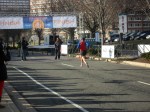
The course was an out and back that started near the Pacers in Pentagon Row right next to the ice skating rink. We ran by the Pentagon Row shops before turning onto Army Navy Drive and going straight up a steep hill. It wasn’t as bad as I remembered from the days I used to run those roads when I worked in Crystal City, but I was certainly breathing heavy. At the top of the hill we were treated to a long, gradual descent (all I could think was oh man, I have to come back up this!), and then some flat and some rolling roads to the turnaround.

My first mile was a bit faster than the rest, but my splits were relatively close to even. I ran mile 1 in 7:13 followed by miles 2 and 3 in 7:22 and 7:26. I finished with a kick to the finish at a 6:23 pace. I was really thankful that I’ve been working on my form both going up and going down hills. I felt like I was flying coming back down the steep hill before turning onto Joyce St. for the final kick to the finish. I leaned forward and let gravity take over, but remembered to land as softly as possible so I wasn’t pounding my legs into the ground.

I crossed the line in 22:56 for an average pace of 7:23 per mile. (My watch was pretty close to that showing a 22:55 finish for 3.14 miles at a 7:18 pace.)That put me in 160th place out of 1,721 overall and 48th out of 1,083 females. I had a blast running this race and will definitely sign up for LTRYW again next year. There were some great costumes and themed running outfits, and free bloody mary’s at Champps after the race topped off a great morning!

Did you race last weekend? Let me know how it went!

Setting Race Goals

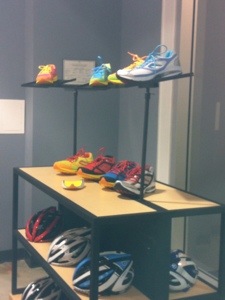
Last night I headed out to Falls Church for Tri360’s clinic: Big Goals for 2013 Panel. Tri360 is a new triathlon store in the area that I’ve wanted to check out for awhile, and it’s very cool. The space is awesome and they’ve got a great assortment of bikes and gear for all three disciplines as well as a service area for bike repairs and maintenance.

I’ve been biking a bit lately since I haven’t been able to run and am really enjoying it. I haven’t done a triathlon in years, mostly because I got frustrated with the fact that I’m not very good at either the swim or bike portions. I’ve been thinking about giving it another go though when I get back into running, so I have some other outlets to keep me from overdoing it on the running right away.

Tri360 put together a great panel of professional and elite triathletes, an elite cross/mountain biker, an Ironman finisher and a swim/run coach resulting in some really good advice and an info-packed discussion. They talked about setting realistic goals based on your fitness level and time to train to avoid burnout and set yourself up for your best chance at success.

The panelists reminded us that goals don’t just have to be about your finish time or place, but can focus on other things like improvement and attitude. It’s also helpful to have training goals and to document your progress so you can look back and see how far you’ve come. Set your goals based on what’s right for you, not based on a competition with someone else – especially if you’re not at comparable fitness levels.

A big theme of the night was achieving balance between training and the rest of your life. Family, friends and work shouldn’t suffer because of your training. Having family or friends that don’t participate in swim, bike and run with you can be really beneficial – sometimes you need to “step out of the bubble”. They also talked about remembering to have fun and the reasons why you do this. If you’re not having any fun then what’s the point.

I really enjoyed the clinic and loved the store. I’ll definitely be back!

Other than the 2013 Marine Corps Marathon, I’m still planning out my race goals for next year. Let me know what your big goals are for next year in the comments!

20121115-221831.jpg


20121115-222243.jpg

20121115-222306.jpg

Book Review: Hansons Marathon Method

Since I currently can’t get my usual running fix (more to come on that in tomorrow’s post), I’ve started reading about running. Yes, I’m addicted. I’ve been familiar with the Hansons-Brooks Distance Project and the great professional athletes they’ve produced including Desiree Davila, so I was excited to hear that they had a new book out detailing how everyday runners can use their method for marathon success.

Thanks to my impulse buying and Amazon Prime membership, I had a copy of Hansons Marathon Method: A Renegade Path To Your Fastest Marathon in my hands just two days after learning about it. Written by Luke Humphrey, an elite Hansons runner who also has a master’s degree in exercise science, with Kevin and Keith Hanson, the book outlines their philosophy and program for a successful marathon covering every aspect from training to strategy to recovery. In just a couple of days I’d read the book from cover to cover and I was sold. I’m going to give their program a shot for my next marathon.

Most marathon training programs are fairly similar. For beginners you usually run three shorter runs during the week and a long run on the weekend peaking around 20 or 22 miles. As you get more advanced, speed workouts and higher mileage are added to the training schedule, but the long run – still peaking at 20 or 22 miles – remains a staple of most programs. The Hansons method takes a different approach. It “teaches a strategic and scientifically grounded approach to everything from the long run to speed workouts to pacing,” writes Kevin Hanson in the book’s foreword. The Hansons method has evolved over the years helping runners of all levels to marathon success since the 1990s.

The biggest difference in the Hansons program is the long run. Rather that the typical 20-miler, the longest training run in the standard Hansons program is 16 miles. The reason this works, Humphrey writes, is that the long run should simulate the last 16 miles of the marathon, not the first 16. It’s all based on experiencing the cumulative fatigue you experience in a marathon without completely zapping your energy for the next week of training. The book cites a guideline that your long run should not exceed 25-30 percent of your weekly mileage. For beginners who have completed just three short runs during the week,  a 20-miler on Sunday can sometimes be 50 percent or more of their weekly mileage. This can be demoralizing and lead to injury – both of which can turn people off from running.

The book covers the philosophy behind the program and delves into the physiology of running covering issues like glycogen depletion and VO2 max. From there Humphrey’s discusses the training program components including easy mileage, which is made up of warm-ups and cool downs, easy days and recovery days, and something of substance (SOS) workouts, which include speed, strength, tempo runs and long runs. The book goes over proper pacing for each of type of run before outlining it’s training programs including both a beginner program and an advanced program. It also talks about program  modifications for when life and injuries get in the way.

After covering the program, the book moves into the strategy side of things. It talks about setting race goals; how to incorporate supplemental training such as cross-training, strength-training and flexibility; and marathon nutrition and hydration during workouts, on race day and for recovery. It moves on to marathon gear, race tactics and post-race recovery – leaving no stone unturned. Finally, the book includes an appendix showcasing the elite Hansons program and describing how its principles are very similar to the ones in their beginner and advanced programs for everyday runners. It even shows Humphrey’s training program for the 2011 San Diego Rock ‘n’ Roll Marathon (this course was my first marathon back in 2005!) where he placed fifth in a personal best time of 2:14:27.

If you’re a runner, you’ll want to give this book a read. Even if you decide to stick with your current training program, you’ll most certainly learn something from it. I’d love to hear about the programs you’ve used in the past, and if you’ve had experience with the Hansons method in the comments section.

Running in the Rain

The October 7 Run for the Parks 10k got here before I knew it. Where is this year going? Everytime I blink another month goes by. Naturally, I still hadn’t seen a doctor about the tightness and pain that started in my hip flexors this summer, so this was going to be another race that I treated more like a training run than an actual race. I wasn’t thrilled about that and I really wasn’t thrilled that temperatures were supposed to drop 25-30 degrees overnight the morning of the race.

This face pretty much sums up my race day attitude!

Put on by the Potomac River Runners, the Run for the Parks 10k was held in West Potomac Park. This has always been my least favorite stretch of races like Marine Corps and Cherry Blossom, but since it’s right around the corner from my office I force myself to frequently run it on my lunch time and post-work runs. I still share a love-hate relationship with this flat, quiet and windy stretch of road, but it’s actually starting to lean more towards love.

I woke up early on race morning already angry about not getting to sleep in after only catching a couple hours of sleep. Seeing it was 40s and rainy didn’t make me much happier. West Potomac Park doesn’t have any real close public transportation so I took my negative attitude over to the closest bike share rack and rode my way into D.C. for the race. I was at least pleased with myself for not bagging the race and crawling back into bed.

I lined up at the starting line pretty chilly, but warmed up quickly. We headed down Ohio Drive and around the bend at Hains Point before turning around and tracing our steps back toward the finish. I started slightly faster than I planned, slowed in the middle and sped up again for the last two miles. My hips were annoyingly tight once again so I averaged a 7:50 per mile pace, which for a 10k is slow for me. (For anyone that’s annoyed by that, years ago that would have been a quick 10k pace for me – it’s all relative and fast and slow is different for every runner.) My finish time was 48:40 good for 16th in my age group and 56 out 643 female finishers, so I can’t complain too much.

The rain wasn’t bad, but it held steady throughout the race, and the temps weren’t showing any signs of rising. All I wanted to do after crossing the finish line was go home and take a hot shower, but I noticed that Fast Track Physical Therapy was on-hand giving massages and free injury consults. I figured it was finally time and signed up for the waiting list for an injury consult. It didn’t take them long to tell me I was in fact injured and needed to stop denying it. I set up an appointment to visit their office, and will hopefully get to the bottom of this soon so I can get back to a training schedule and working toward Boston again!

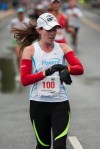
On a side note, I’m pretty sure my finish line pic (courtesy of Potomac River Running’s Flickr page) could rival some of Mark Remy’s best “race face” pics.

Revenge of the Penguins 20 Miler Recap

I’ve been neglecting my blog for far too long and have some catching up to do now. When I initially signed up for this race, I was going to use it as one of my 20-miler training runs along the way to MCM. However, with the continuing hip issues I hadn’t run further than seven miles for my long runs, so I wanted to use this as a test to see if it still made sense to run the Marine Corps Marathon this October. The results weren’t all bad, but they certainly weren’t good either.

The Revenge of the Penguins 20 Miler ran along the C&O Canal path starting near the Key Bridge in Georgetown on a beautiful, sunny and cool mid-September morning. The race start was only about a mile from my apartment so I walked over that morning with just what I needed to race and my keys and cell phone stuffed in my water pack. I was worried there wouldn’t be a bag drop being such a small race, but it turned out there was, so I really wish I’d brought a hoodie along to keep warm before the race started.

A few hundred people gathered near the start ready to run either the 20-mile or 10-mile options. Race organizers and volunteers were energetic and enthusiastic from start to finish making this a great low-key race. For those that know the C&O, it’s a pretty narrow path, so the 20-milers took off a few minutes before the 10-milers to cut-down on early crowding.

For the first-time ever in a race I wore headphones. It was a last minute decision so I didn’t even have my iPod, I just used my phone. I’m normally very against this because I think that you miss out on the race experience and it can also be dangerous. Seeing as this was along a canal path, there wasn’t going to be crowds of spectators cheering along the way and there wouldn’t be any traffic to worry about. Still, I kept the volume low so I could hear other runners approaching and hear any directions from volunteers at water stops. As I ran almost the entire race on my own at a much slower pace than I’m used to, I’m pretty glad I had the music taking my mind off things.

My plan was a slow, steady race pace so as not to aggravate my hip flexors. One of the positives I took away from the race is that I actually maintained a steady pace with a small negative split (negative split is runner-speak for running the second half of a race quicker than the first half). I have a tendency to start off too strong and slow up, so I was pleased that I kept it steady for all 20 miles. I enjoyed the out-and-back along the canal. I frequently run on the Capital Crescent trail very close to the C&O path, so this was a nice change of scenery, and we could not have had better weather.

I crossed the finish line in 2:59:11, sixth in my age group and 46th out of 184 overall. Everyone’s GPS watches had the course at about 20.3-20.4, so I averaged just over an 8:45 pace. I was pleased with how it turned out, especially given the lack of training, and I certainly didn’t mind the post-race pizza and snacks before my walk home! My only issue was receiving Powerade Zero at the finish. Now I appreciate anything that’s free, but come on, I just ran 20 miles – give me some calories!

After the race I made the tough decision to defer my entry in Marine Corps to next year’s race. I only had a few days left to defer, and I knew that there was no way between then and race day that I could get the mileage in at the paces I needed to to reach my Boston Qualifying goal time. I could go out there and run the race at a slow pace just to finish as I have done with marathons before, but I know I wouldn’t enjoy that this time. I’m bummed about missing the race as it’s one of my favorites, but I’m excited about getting healthy and competing in it next year. I’m already starting to plan out my race schedule for the rest of next year as well. I can’t wait to get more details on the newly announced Nike Women’s half in D.C.